
Evil Mad Scientist Laboratories Evil Mad Scientist Laboratories

Making the World a Better Place, One Evil Mad Scientist at a Time

 
About EvilMadScientist  :  Buy Stuff  :  Contact  :  Forums  :  Links  :  Articles  :  Search  

How to make the simplest electric motor

You have one drywall screw, one 1.5 V alkaline cell, six inches of plain copper wire, one small neodymium disk magnet, and no other tools or supplies. You have 30 seconds to make an electric motor running in excess of ten thousand RPM. Can you do it? Surprisingly enough, you can.


Let's take a step back. The most common type of electric motor is the brushed dc electric motor. This is the kind that you'll find inside essentially everything that moves (or shakes) and runs on batteries. This type of motor attracts an electromagnet towards a permanent magnet. When the two are close enough,the polarity of the current through the electromagnet is reversed, so that it now repels the permanent magnet, and thus keeps turning. It's quite easy to build a working model; Christian built this example for his third-grade science project.

A simpler yet motor (sometimes sold as the sold as the "world's simplest motor") just switches off the current for half of the cycle, letting the angular momentum of the spinning motor armature carry it through. In Make Magazine Volume 1, the Howtoons comic shows how to make an electric motor that works that way.

None of these is really the simplest motor. The real champion is the homopolar motor.

Ready to build one? Let's get started:

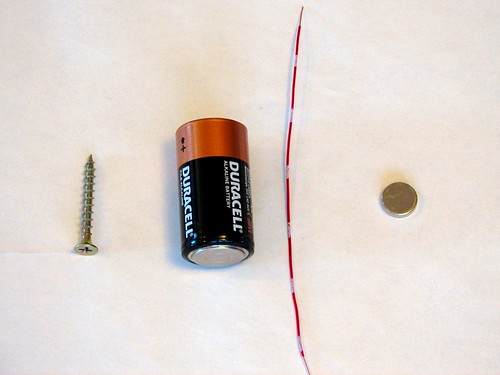
The ingredients (L-R): One ferromagnetic screw, one battery cell, a few inches of copper wire, and a neodymium disk magnet.

I used a drywall screw both because it has a flat head and because it's easy to tell when it's turning. You can use a nail instead. The battery needn't be any particular type; an alkaline C-cell works fine and is easy to hold. Just about any copper wire will work fine for this application. I used some wire with partially stripped (and partially striped) red insulation that is easy to see in the photos. Bare copper will work just as well.

The magnet came from an LED throwie with a dead battery. The best magnets for this job are neodymium disc magnets with a conductive plating. You can get them from plastic toys or buy them from a number of magnet discount and surplus shops.
Homopolar - 2.jpg
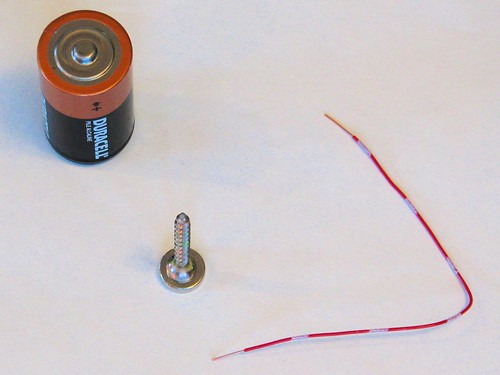
Set the screw on the magnet, bend the wire.
Homopolar - 3.jpg
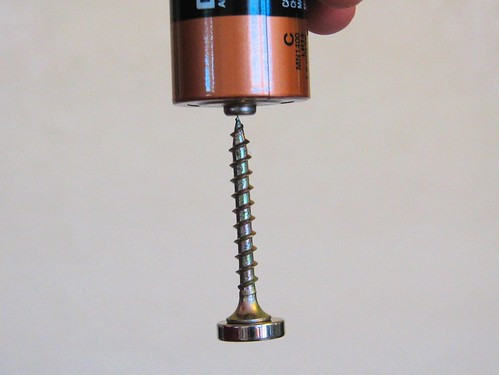
Attach the magnet to one end of the battery. The weak, single-point contact that you are making serves as an low-friction bearing. I like to attach it to the button end, but the other end will work as well. (If you do so, the motor will spin the opposite direction. You can also reverse the direction by flipping the magnet up side down.)

(Note to physics geeks: The heavier your magnet plus screw system is, the lower the friction will be, right up to the point that magnet isn't strong enough to hold them any more. This is because the friction force is proportional to the normal force. In other words, a bigger magnet is usually better.)
Homopolar - 4.jpg
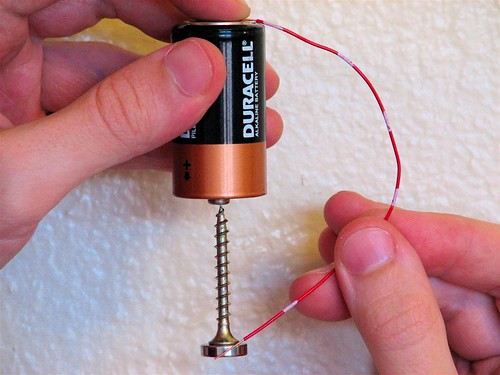
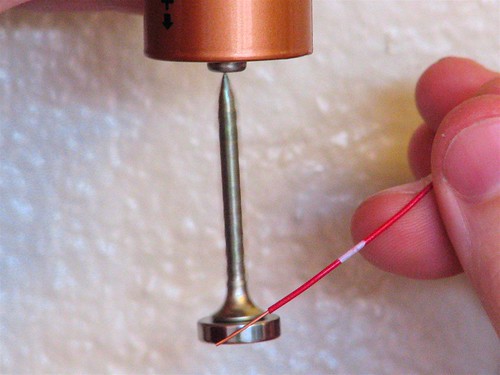
Press and hold the top end of the wire to the top end of the battery, making an electrical connection from the top battery end to the wire.
Homopolar - 5.jpg
Here we go: Lightly touch the free end of the wire to the side of the magnet. The magnet and screw start to spin immediately. We can get ours up to 10,000 RPM in about fifteen seconds.

Watch out: The screw and magnet can easily fly out of control, and you do not want that screw ending up in your eye. Also note that some of the components, like the wire, can get very warm while you're doing this. Wear safety glasses and use common sense!

Short movie (25 s): spinning up the motor (Choose your format)

Download high-res quicktime movie (1.6 MB)
Watch the low-res version on YouTube


Wondering what to try next? You may also like this project, which is about building a similar sort of motor that spins water instead of a magnet.


How does this work?

When you touch the wire to the side of the magnet, you complete an electric circuit. Current flows out of the battery, down the screw, sideways through the magnet to the wire, and through the wire to the other end of the battery. The magnetic field from the magnet is oriented through its flat faces, so it is parallel to the magnet's axis of symmetry. Electric current flows through the magnet (on average) in the direction from the center of the magnet to the edge, so it flows in the radial direction, perpendicular to the magnet's axis of symmetry. If you took physics at some point, it's possible that you'll remember the effect that a magnetic field has on moving electric charges: they experience a force that is perpendicular to both their direction of movement and the magnetic field. Since the field is along the symmetry axis of the magnet and the charges are moving radially outward from that axis, the force is in the tangential direction, and so the magnet begins to spin. Neat! For a slightly more thorough explanation, have a look at the end of this article, which is about a magnetohydrodynamic homopolar motor.

It's called a homopolar motor because you never need to reverse the polarity of any motor component during operation, unlike the other types of motors that we've described. I first learned about this type of motor in an article by David Kagan, in the magazine The Physics Teacher, February 2005. It turns out that it's been around longer than that: it was invented in 1821 by Michael Faraday. Somewhat surprisingly, this is more than just a curiosity: motors of this design are currently being developed for quiet, high-power applications.
Homopolar - 6.jpgFinal note: How do we measure the rotational speed of the motor?
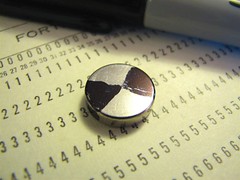
You can get an optical tachometer for $20 or less, intended for use with model airplanes. I have model LXPT31 from Tower Hobbies, which is expecting to see an airplane propellor with two blades. I added two wide black stripes to the magnet with a Sharpie, which allow the tachometer to read the rotational speed of the motor. Pointing the tachometer at the magnet and spinning up the motor, we were able to clock a speed above 10,000 RPM after spinning up for about fifteen seconds. Spiffy.


MetaBlog links for this story: [ del.icio.us | digg | redditt | technorati ]
Technorati tags: , , , , , , , ,

Trackback

Trackback URL for this entry: http://www.evilmadscientist.com/trackback.php/HomopolarMotor

Here's what others have to say about 'How to make the simplest electric motor':
Make an electric motor in 30 seconds from Boing Boing
This is the simplest electric motor I've ever seen. Watch the movie to see how fast it spins. Link... [read more]
Tracked on Monday, August 07 2006 @ 12:19 PM PDT
Charon QC :: Make a very fast motor
Tracked on Monday, August 07 2006 @ 12:59 PM PDT
Keys Corner :: Blog Archive :: You have 30 seconds to make an electric motor from these:
Tracked on Monday, August 07 2006 @ 03:15 PM PDT
HOW TO - Make the simplest electric motor from MAKE: Blog
MAKE Flickr photo pool member Oskay shows you how to make a super simple motor, he writes - "You have one drywall screw, one 1.5 V alkaline cell, six inches of plain copper wire, one small neodymium disk magnet,... [read more]
Tracked on Monday, August 07 2006 @ 04:56 PM PDT
http://www.diyhappy.com/simple-electric-motor/
Tracked on Monday, August 07 2006 @ 05:22 PM PDT
http://stuff.nekhbet.ro/2006/08/07/how-to-make-the-simplest-electric-motor.html
Tracked on Monday, August 07 2006 @ 05:33 PM PDT
Brian's Blog :: Nice little project
Tracked on Monday, August 07 2006 @ 06:17 PM PDT
FarmGeek - Farm tech, geek stuff, living sustainably :: The world's simplest electric motor - really!
Tracked on Monday, August 07 2006 @ 06:26 PM PDT
The Simplest Electric Motor from Plasser.net
Build a homopolar motor from a drywall screw, one 1.5 V alkaline cell, six inches of plain copper wire and one small neodymium disk magnet. [read more]
Tracked on Monday, August 07 2006 @ 07:16 PM PDT
How to Build an Electric Motor ~ Lockergnome's Doing It
Tracked on Monday, August 07 2006 @ 07:27 PM PDT
Terrorpilots :: Archivio Blog :: Surfing [14]
Tracked on Monday, August 07 2006 @ 08:29 PM PDT
Como hacer un simple motor electrico at Blogfera: Tecnologia, Internet y Actualidad.
Tracked on Monday, August 07 2006 @ 09:34 PM PDT
Dvorak Uncensored :: Video: The Simplest Motor In The World
Tracked on Monday, August 07 2006 @ 10:59 PM PDT
glaubdes.net :: Blog Archiv :: howto: elektromotor in 30 sekunden
Tracked on Tuesday, August 08 2006 @ 02:16 AM PDT
Lauro Moura :: Criando o motor eletrico mais simples possivel
Tracked on Tuesday, August 08 2006 @ 06:39 AM PDT
How to make an electric motor from A Life Less Interesting
Step 1 - Find a battery, a scren, a small magnet and a short piece of wire. Step 2 - Assemble them as described on this page Step 3 - Enjoy!... [read more]
Tracked on Tuesday, August 08 2006 @ 12:08 PM PDT
Paging MacGuyver from IainBurns.com
The folks over at Evil Mad Scientist have come up with a way to make a 10,000rpm motor with the following simple, household items: Full story here. ... [read more]
Tracked on Tuesday, August 08 2006 @ 01:06 PM PDT
apoloni.com.br :: Blog Archive :: Como montar um motor eletrico em 30 segundos
Tracked on Tuesday, August 08 2006 @ 02:29 PM PDT
How to make the simplest electric motor
Link: Evil Mad Scientist Laboratories - [read more]
Tracked on Wednesday, August 09 2006 @ 12:10 AM PDT
Geschmacksberater :: Blog Archive :: Motorbiene
Tracked on Wednesday, August 09 2006 @ 08:17 AM PDT
Motorbiene from Geschmacksberater
Aus dem Labor des Bose-bekloppten Wissenschaftlers[1] kommt die Bauanleitung fur einen Elektromotor... Nicht wirklich nutzlich, aber cool. [read more]
Tracked on Wednesday, August 09 2006 @ 08:17 AM PDT
Potame.com :: All the freaky people make the beauty of the world
Tracked on Wednesday, August 09 2006 @ 11:13 AM PDT
Attu Sees All: Simplest electric motor
You have one drywall screw, one 1.5 V alkaline cell... [read more]
Tracked on Wednesday, August 09 2006 @ 03:24 PM PDT
EGM Weblog :: Der Elektromotor des McGyver
Tracked on Thursday, August 10 2006 @ 04:20 AM PDT
El Club del Tetraedro :: Construye un motor en 30 segundos
Tracked on Thursday, August 10 2006 @ 11:16 AM PDT
SKaRCHa :: El motor electrico mas simple
Tracked on Thursday, August 10 2006 @ 04:06 PM PDT
http://kimchang.jugem.cc/?eid=1589
Tracked on Thursday, August 10 2006 @ 04:18 PM PDT
Con problemas .... from yanawara
Hoy se suponia que deberia de poner varias publicaciones, lamentablemente tuve problemas con el acceso al blog , lo bueno es que esta cerca lo de adquirir un servidor propio ilimitado, y si vieran el problema que tuve ahora con el pc ,, hasta un [read more]
Tracked on Friday, August 11 2006 @ 04:33 AM PDT
la tarde :: Prof. Machaquito nº X :: August :: 2006
Tracked on Sunday, August 13 2006 @ 03:50 PM PDT
Total bekloppte Wissenschaftler - Skatsboard - Unterhaltung, Diskussionen, Tipps
Tracked on Tuesday, August 15 2006 @ 04:16 AM PDT
El Calabozo »
Tracked on Friday, August 18 2006 @ 05:24 AM PDT
The simplest electric motor ever from GrumbleGeek
Max sent along this seemingly improbable link to "the simplest electric motor." Check it out before reading further:http://www.evilmadscientist.com/article.php/HomopolarMotorSince I had the stuff on hand to make one of these (and by the way we'll talk... [read more]
Tracked on Saturday, August 19 2006 @ 07:14 AM PDT
Last » Blog Archive » æ?¥å?šä¸€ä¸ªæœ€ç®€å?•的直æµ?电机
Tracked on Saturday, August 19 2006 @ 09:06 PM PDT
No puedo creer que lo hayan inventado… » Crea un motor eléctrico en 30 segundos
Tracked on Sunday, August 20 2006 @ 01:50 PM PDT
Ireneo's Memory » How To Extract Magnets From Plastic Toys
Tracked on Tuesday, August 22 2006 @ 05:34 AM PDT
Untitlog » Blog Archive » How to make the simplest electric motor
Tracked on Thursday, August 24 2006 @ 12:42 PM PDT
Boby's Blog » Crea un motor electrico a lo McGiver
Tracked on Monday, August 28 2006 @ 12:25 PM PDT
Aprendendo Fisica » Menos e mais tambem na sala de aula!
Tracked on Friday, September 08 2006 @ 10:42 AM PDT
Menos é mais, também na sala de aula from BlogeFísica
Geralmente se pensa que uma aula de física será mais interessante se levarmos toneladas de equipamentos para demonstrarmos um conceito ou aplicação... Mas isso não é necessariamente verdade :-) Vejam o motorzinho absurdamente simples (em tese) n... [read more]
Tracked on Friday, September 08 2006 @ 11:46 AM PDT
http://www.blogim.org.il/hachatif/1084/%E4%E7%E8%E9%F3+%E4%F9%E1%E5%F2%E9+%EE%F1%F4%F8+5.html
[read more]
Tracked on Sunday, September 10 2006 @ 12:31 AM PDT
InterneoX » Blog Archive »
Tracked on Tuesday, September 19 2006 @ 06:24 AM PDT
http://www.solo-technology.com/blog/2006/09/23/simple-electric-motor/
Tracked on Saturday, September 23 2006 @ 11:53 PM PDT
Hilavitkutin.com » Blog Archive » Rakenna sahkomoottori 30 sekunnissa
Tracked on Monday, October 02 2006 @ 06:24 AM PDT
Make your own homopolar motor from BloggingBaby
Last Saturday, I attended the October meeting of the Atari Bay Area Computer Users Society (ABACUS) where one of our members challenged us to build a working motor out of a battery, a screw, a short piece of wire, and a couple of magnets in under 30 seconds. [read more]
Tracked on Monday, October 09 2006 @ 01:33 PM PDT
2dayBlog - Technology Journal, New Gadget everyday! » Blog Archive » 2day’s How-To: Make Simple
Tracked on Monday, October 09 2006 @ 09:43 PM PDT
http://www.tonkatsu3.com/index.php?%A5%DB%A1%BC%A5%E0%2F2006-10-12 from tonkatsu3
Tracked on Wednesday, October 11 2006 @ 07:07 PM PDT
The Stingy Scholar » Blog Archive »The Simplest Electric Motor
Tracked on Tuesday, October 17 2006 @ 06:35 PM PDT
How To Spot A Psychopath :: Science toys! :: October :: 2006
Tracked on Thursday, October 19 2006 @ 01:50 PM PDT
Mexico501 » Blog Archive » How to make the simplest electric motor
Tracked on Friday, October 27 2006 @ 03:50 AM PDT
a thaumaturgical compendium » Blog Archive » Remaindered Links:
Tracked on Thursday, November 02 2006 @ 01:37 PM PDT
gluuu » Blog Archive » Evil Mad Scientist . com
Tracked on Saturday, December 23 2006 @ 10:46 PM PDT
" + title + "
Tracked on Thursday, December 28 2006 @ 08:00 AM PDT
La Vie Est Une Fête ! » Blog Archive » Des cadeaux pour toi
Tracked on Thursday, December 28 2006 @ 06:03 PM PDT
Who is DuJun ? » 如何制作一个最简å?•的电动机ï¼?
Tracked on Sunday, December 31 2006 @ 02:26 AM PDT
ArchiSpass :: Evil Mad Scientist
Tracked on Sunday, January 21 2007 @ 05:45 AM PDT
Pereiraâ„¢ Web Blog » Archivo del weblog » Viernes de hueva…
Tracked on Thursday, March 01 2007 @ 09:07 PM PDT
Homopolar motor movie - YouTube from Think Different, Act Evil !
Tracked on Tuesday, April 03 2007 @ 09:42 AM PDT
Bakje.nl Jatlog » Schroefje draaien
Tracked on Wednesday, April 04 2007 @ 05:29 PM PDT
mincus code » The Secret to the Search Engine Long Tail - Firefox, Perl, Javascript
Tracked on Friday, April 06 2007 @ 06:08 AM PDT
Electricidad y Electrónica » Blog Archive » MOTOR HOMOPOLAR
Tracked on Friday, May 04 2007 @ 06:25 AM PDT
http://www.diyhappy.com/homopolar-motor/
Tracked on Tuesday, June 12 2007 @ 02:06 AM PDT
Actual Technology News Blog » How to make the simplest electric motor
Tracked on Thursday, July 19 2007 @ 03:37 AM PDT
dblog-Tech News And Other Humorous And Frightening Things From Around The Web
Tracked on Tuesday, October 09 2007 @ 04:28 PM PDT
Faça um motor elétrico em 30 segundos!
Tracked on Sunday, October 21 2007 @ 08:56 AM PDT
Crealo tu mismo >> Blog Archive >> Construir un motor eléctrico en menos de un minuto
Tracked on Friday, December 21 2007 @ 06:14 PM PDT
76 Links to Web-apps, Tutorials, Tips, and Fun
Tracked on Saturday, December 29 2007 @ 03:43 PM PDT
How to make the simplest electric motor | 41 comments | Create New Account
The following comments are owned by whomever posted them. This site is not responsible for what they say.
Avoid mentioning who told you the idea?!
From: wbeaty on Monday, August 07 2006 @ 04:35 PM PDT
Not cool: this author is NOT the inventor of this motor. If they got it from their physics teacher, they should say so. (But perhaps they just didn't realize that if they hide the source of the idea, that's almost the same as pretending to be the original inventor.) In reality, physics teachers have been playing with this version of Homopolar Motor for some time. The following website says it came from some physics teachers in Japan, called "The Stray Cats." http://scitation.aip.org/journals/doc/PHTEAH-ft/vol_42/iss_9/553_1.html
There's also a different version on SciToys website: http://sci-toys.com/scitoys/scitoys/electro/homopolar/homopolar.html
How to make the simplest electric motor
From: Anonymous on Monday, August 07 2006 @ 06:41 PM PDT
Adding a plate of metal in a disc shape after screw and before the magnet would make it more stable. The plate would work as a gyro.
How do you know your tach is accurate?
From: Anonymous on Monday, August 07 2006 @ 09:22 PM PDT
Read what the vendor of your device has to say:

This Tachometer uses a sensitive photocell to measure the number of times the propeller blade crosses between the sensor and the light from the sun. If the readings become erratic, change the direction the model is facing by 90 degrees and take another reading. Do not use indoors, reading will not be accurate.

Your ass got factchecked. Do I win a prize?
How to make the simplest electric motor
From: Anonymous on Monday, August 07 2006 @ 11:09 PM PDT
I love it! I just wish this site had been around when I was at school (or the internet for that matter :-) I would have gotten into sooo much more mischief than I did. Keep the great geek/tech ideas coming. --FarmGeek farmgeek.co.nz
I wouldn't call it a MOTOR
From: Anonymous on Tuesday, August 08 2006 @ 08:10 PM PDT
By definition, a motor imparts motion to SOMETHING.

This thing is just a whirligig. Would you call a pinwheel a motor? A gyroscope?

Also, you forgot to mention that you need gravity for this thing to work. It obviously wouldn't be useful in zero-G. The moment you touch it with the wire, it would spin off the battery. The gravity pulling downward keeps it spinning.

How many joules of angular momentum is this thing generating?
where...
From: Anonymous on Wednesday, August 09 2006 @ 02:37 AM PDT
do i get a neodymium magnet
How to make the simplest electric motor
From: Anonymous on Monday, August 14 2006 @ 10:52 PM PDT
That is so cool.. I've never seen it before and had to try it... it does work.. cool... and after i had power applyed for about 20 seconds it took well over 5 minutes to spin down.

One question...

Can you tell me why my cat is so enthralled by it?? I mean she'll jump into my lap to investigate it, & she's not a lap cat.... Doesn't even like to be petted. Is it making some kind of noise?

-PurpleJesus
-not affiliated with any soul ripping agencys

What does 'simple' mean?
From: kinsler33 on Thursday, August 17 2006 @ 01:10 AM PDT
This is long, and has to do with the term 'simple.' A simple
motor may be simple because, like this one, it has only four parts including the battery and the wire. A simple motor might also be simple if it is simple to understand, which this one is definitely not.

I assume that since most ceramic magnet materials are poor electrical conductors, the current goes out of the battery, down the screw, through the nickel plating of the magnet, and then down to wherever the wire is touching the edge of the magnet. The magnetic field is normal to the top flat surface of the magnet, and the current is radial across it, so we get the crossing of an electric and a magnetic field and thus enough push to spin the magnet.

This ain't so simple. The classic homopolar motor with the copper disk and the horseshoe magnet is simple in appearance, and when explained it sort of makes some sense to the uninitiated, so it isn't a great teaching tool, either, notwithstanding that you can't use mercury for the lower contact these days.

The simple motor I designed uses an electromagnet, a switch, and a steel bar pivoted on good bearings halfway along its length. The electromagnet is placed near the bar and attracts whichever side of the bar happens to be nearby, and the switch is switched on and off at the appropriate time by the action of the rotating bar. Not particularly clever, but you can see it work and feel it work when you push the bar around by hand and feel the electromagnet grab it.

There are still people who think it's pretty much magical, I'm afraid, but we do our best.

M Kinsler
How to make the simplest electric motor
From: Anonymous on Tuesday, October 31 2006 @ 02:03 PM PDT
Excelent toy. I duplicated it and it`s nice to look at. Just so few details ant it runs at such high RPM`s :)
Every grown man (so I am) can play with such a toy for hours :) Coz it`s fun. And there we have possibility to invite ours kids into science world using some interesting demo. Such a toy should be a must in any physics choolbook.

Now, let`s start it in reversed mode e.i. - generator. As far as I heard rumours - such a type of motor reversed to generator should not produce back EMF while generating electricity.
High amperes and low voltage of course. Homopolar Faraday`s generator ??
How to make the simplest electric motor
From: electric motor on Thursday, April 26 2007 @ 04:12 AM PDT
Wow, I liked that, nice work cool.
How to make the simplest electric motor
From: Anonymous on Sunday, October 14 2007 @ 04:34 PM PDT
For every action there is an equal and opposite reaction. There is a torque on the magnet, but where is the equal and opposite counter-torque?
How to make the simplest electric motor
From: Anonymous on Friday, December 14 2007 @ 04:31 PM PDT
What I made is a homopolar motor without neodymium magnet

http://www.metacafe.com/watch/966291/homopolar_motor_without_neodymium_magnet/
How to make the simplest electric motor
From: Anonymous on Wednesday, December 19 2007 @ 06:45 PM PDT
WOW
How to make the simplest electric motor
From: Anonymous on Friday, February 01 2008 @ 08:57 PM PDT
GAAAAHHHH!!!!!! I would have more luck moving the damn thing with my mind than this, now before anybody says anything, YES it's probably my materials. Soooo, does anybody have any tips to give me!!!??
How to make the simplest electric motor
From: Anonymous on Tuesday, February 05 2008 @ 04:41 PM PDT
I hate ur website it is to complicated im only in kindergarten
How to make the simplest electric motor
From: Anonymous on Wednesday, February 27 2008 @ 04:55 PM PDT
my class has a better idea you use an motor,wire,swich plate and a battery this is easier!!!!!!!